Schedule reliability fell to 56.4%. Shanghai went to 21%.
Six days late on a weekly string. Whose berth is that?
Sea-Intelligence's July figures are mostly a weather story at origin and a berth-window story everywhere else. The 44-point spread between the best and worst of the top 13 carriers is where proforma design shows.
July's fall in schedule reliability was mostly weather, but the six-day average delay matters more than the headline figure. On a weekly service, a ship that late takes the next ship's berth slot, and the delay moves down the line. The wide gap between the best and worst carriers shows how much comes down to schedule design.
The announcement
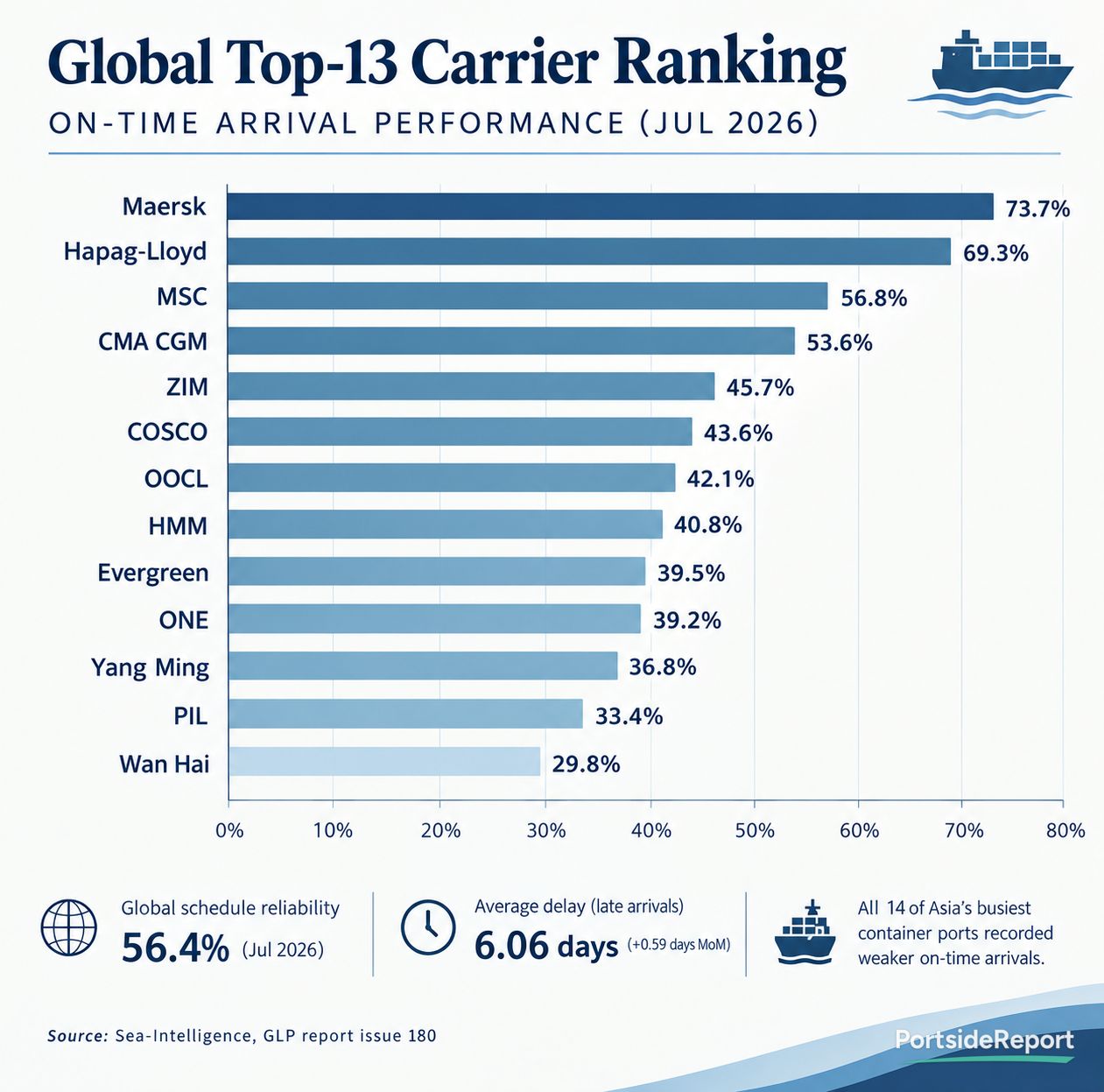
Sea-Intelligence's Global Liner Performance report, issue 180, published 26 August 2026, put global schedule reliability at 56.4% for July, down 6.1 percentage points month on month and 8.8 points year on year. That is the lowest 2026 reading and the lowest since February 2025, and the sharpest single-month fall since January 2021. Average delay for late arrivals rose 0.59 days to 6.06 days, the highest since January 2024. All 14 of Asia's busiest container ports recorded weaker on-time arrivals. Yantian fell 23.5 points to 48.3%. Shanghai fell 19.2 points to 21.0%, which Sea-Intelligence says is the lowest in 14 years of its data outside the pandemic. Maersk led the top 13 carriers at 73.7%, Hapag-Lloyd second at 69.3%, and Wan Hai last at 29.8%. The report covers 34 trade lanes and more than 60 carriers.
What it means
The headline percentage is the least useful number in the release. The one to plan against is 6.06 days.
A weekly Asia-North Europe string runs on a seven-day cadence. When your average late arrival is 6.06 days behind, the late ship is not arriving late into its own window. It is arriving on top of the next voyage's window, at the same terminal, in the same string. Two ships, one slot. The terminal berth planner resolves that by pushing one of them to whatever gap exists, and the gap is rarely the one your stowage was built for. That is how a weather event at Yangshan becomes a load-plan problem in Hamburg six weeks later. Delay in a liner network does not decay. It transfers.
The transfer is landing badly. As of early September, waiting times at Shanghai and Ningbo still ran from several days to more than a week depending on terminal, with the worst Yangshan berthing delays reported past twelve days in contemporaneous analyst notes.
Those ships sail into a North Europe range where German dockers struck for 48 hours from the late shift on 2 September across Hamburg, Bremerhaven, Wilhelmshaven, Bremen, Brake and Emden, and Dutch workers struck Rotterdam, Amsterdam and Zeeland on 4 September. Ver.di is asking 8.2% or at least €2.50 an hour on a 12-month deal against ZDS at 5.1% backdated to 1 August on 18 months, so this is not settled. A vessel that lost six days in China does not get a sympathetic window in a port that just lost two shifts.
What the July numbers do not support is a claim that liner scheduling has structurally broken. Four typhoons closing the two largest container ports in the world inside a few weeks will produce this. 56.4% is poor, it is not 2021. The system responded roughly as you would expect.
The part that is not weather is the spread. Maersk at 73.7% and Wan Hai at 29.8% called at the same congested terminals in the same month. Forty-four points of difference is bought, not earned by luck. It is bought with slack in the proforma, with dedicated or priority berths, and with the willingness to protect core strings by degrading regional and feeder services, which The Loadstar has reported carriers doing. If your carrier sits in the bottom half of that table, the reliability you are quoted is a proforma number, and the proforma has no buffer in it.
Downstream, the practical costs are the ordinary ones, at volume. Omitting a port to recover a day means restowing cargo that was already stowed for it, plus a substitute discharge and a feeder leg. Those costs add up quickly.
Six extra days of transit on reefer cargo is a claims exposure and a genset fuel line for ships sitting at anchor with no shore power. Twelve days at anchor is a crew problem too, because MLC 2006 contract limits do not extend because a berth is unavailable, and a crew change planned for a rotation port that gets omitted has to be rebuilt. On time-chartered tonnage the waiting time is generally on-hire under standard forms, so the charterer pays for the anchorage, subject always to the precise charter-party wording. And anchorage time is the worst possible input to a CII rating, because you burn and log no distance, at a point where EU ETS is at full phase-in on the covered share of voyages.
What would have to be true
For the network to absorb this without another leg down in Q4, several things have to hold at once. Asian berth queues have to clear before Golden Week loading rather than after it. North European labour has to settle, because a strike month layered onto arriving bunching is the scenario that turns 56.4% into something worse. Carriers have to re-cut proformas honestly instead of publishing schedules they know they will miss, which means either adding a vessel to a string or extending the rotation and telling customers the new transit time. Terminals have to be willing to renegotiate window tolerances for the affected strings rather than defaulting everyone to first-come-first-served, which rewards the ship that steams hardest and punishes the one that planned. And planning tools have to measure against a realistic plan. Most schedule systems still treat the published proforma as truth and report deviation from it. At 56% reliability, that report tells you nothing you can act on.
What I would watch
Three signals. First, the August and September GLP readings: if reliability recovers above 60% while the average delay stays near six days, the bunching has been absorbed rather than resolved, and it will resurface. Second, the port-level table rather than the carrier table. Shanghai back above 40% is the real recovery marker. Third, blank sailings on Asia-North Europe in October. Carriers cut capacity to restore schedule integrity, and a rising blank count while rates hold is the honest signal that they are re-cutting rather than pretending.
Sources: Sea-Intelligence press room