MSC and Hutchison restart talks on Rotterdam's Omega terminal
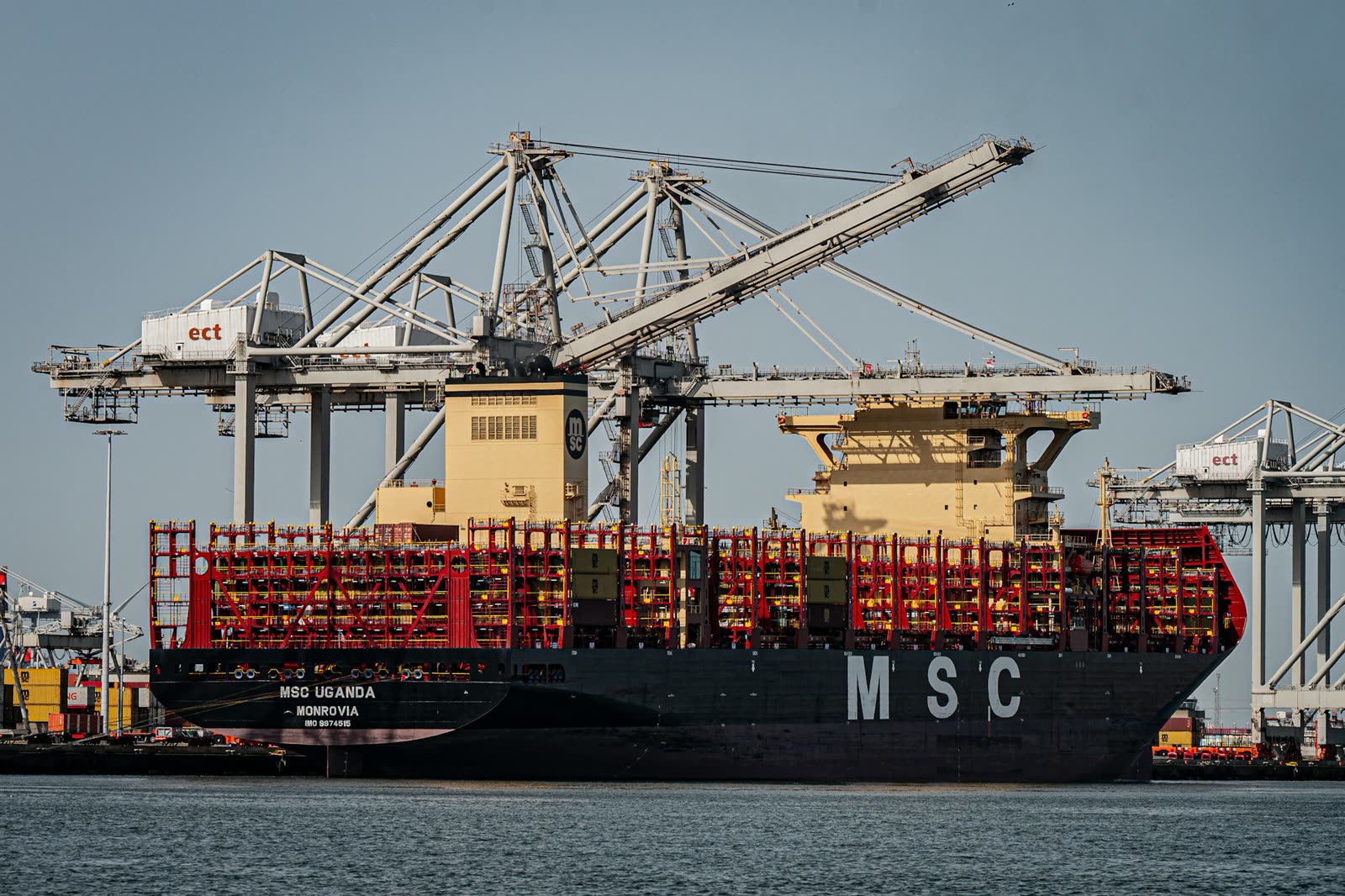
If you call at ECT Delta, 2028 to 2030 likely means tighter berth windows
Why Rotterdam gives up a working terminal before Omega is finished, who carries its ships in the meantime, and the one document that will show the project is real.
MSC's terminal arm and Hutchison are talking again about Omega, a planned terminal in Rotterdam, the Netherlands. Carriers want berths they control in a port short of space. Building Omega closes a working terminal on the way, and the deal waits on a January port deadline and on Hutchison's sale talks, where MSC's arm is a buyer.
Hutchison Ports and Terminal Investment Limited (TiL), MSC's terminal arm, are negotiating again over Omega, a planned container terminal of 6 to 7 million TEU in Rotterdam. The talks stopped in July over key contract terms. Dutch unions FNV Havens and CNV say management told them on 1 October that negotiations had restarted. The Port of Rotterdam wants a decision before 1 January 2027, or it may offer the site to other parties.
The two sides at that table are also buyer and seller. In March 2025, TiL and BlackRock agreed to buy Hutchison's ports business outside China and Hong Kong, and that business includes Rotterdam. The sale has not closed. So TiL is negotiating a joint venture on a site it may later co-own through the purchase. Whatever it signs has to work whether the sale closes or not.
One part of the plan already has dates on it. Omega joins two Hutchison terminals into one: the north side of ECT Delta and Delta II, the terminal next to it. In March, Hutchison management told the unions it expects Delta II to close between 2028 and 2030, while Omega is still under construction. That means Rotterdam loses a working terminal before the new one is finished.
Delta II's ships have to go somewhere during the build. Everything said so far points to ECT. Management wants to lend staff between the two terminals so that Delta II people can settle at ECT during the rebuild.
That leaves ECT Delta and Euromax carrying Delta II's work in a port that is already short of space. In the first half of 2026, Rotterdam's transhipment volume fell 20%. The port blamed capacity constraints at its container terminals. For carriers on the ECT quays, 2028 to 2030 likely means tighter berth windows and less room to recover a late ship.
For Omega to add capacity overall, ECT has to absorb Delta II's work through the build. Enough of Delta II's workforce also has to still be there to run the new terminal. CNV reports that some staff have already left for APM Terminals and other employers.
In January, management told the unions that only two documents were left to sign. One was a cooperation agreement between TiL and Hutchison. The other was a lease with the port authority. Nine months later, neither has been announced. The lease is the one to watch. If the Port of Rotterdam signs it before 1 January, Omega becomes a project with a date. If the port starts talking to other parties about the site, the plan has run out of time.
Primary sources
- officialOnzekerheid bij Delta II duurt voort CNV, 2026-10-06
- officialPeriodiek overleg vakbonden met Delta 2 CNV, 2026-03-18
- officialPeriodiek overleg Delta 2: CNV eist werkzekerheidsgarantie voor alle medewerkers CNV, 2026-01-23
- officialHutchison Ports and Terminal Investment Limited Sàrl jointly announce new terminal in the Europahaven Port of Rotterdam, 2022-08-31