CMA CGM's new 13,000 TEU ship stows part of its deck without lashing
How much port time do you save when only part of the deck has guides?
HD Hyundai has published a gain in deck weight but no count of the guided bays. Here is what a port call looks like on a deck with two securing systems, and what a stowage desk needs answered before planning one.
South Korea's HD Hyundai has delivered CMA CGM a container ship whose deck guides hold part of the cargo without lashing. That saves hard manual work at every port call, but the guides also fix what each slot can take. What it is worth depends on details the yard has not yet published.
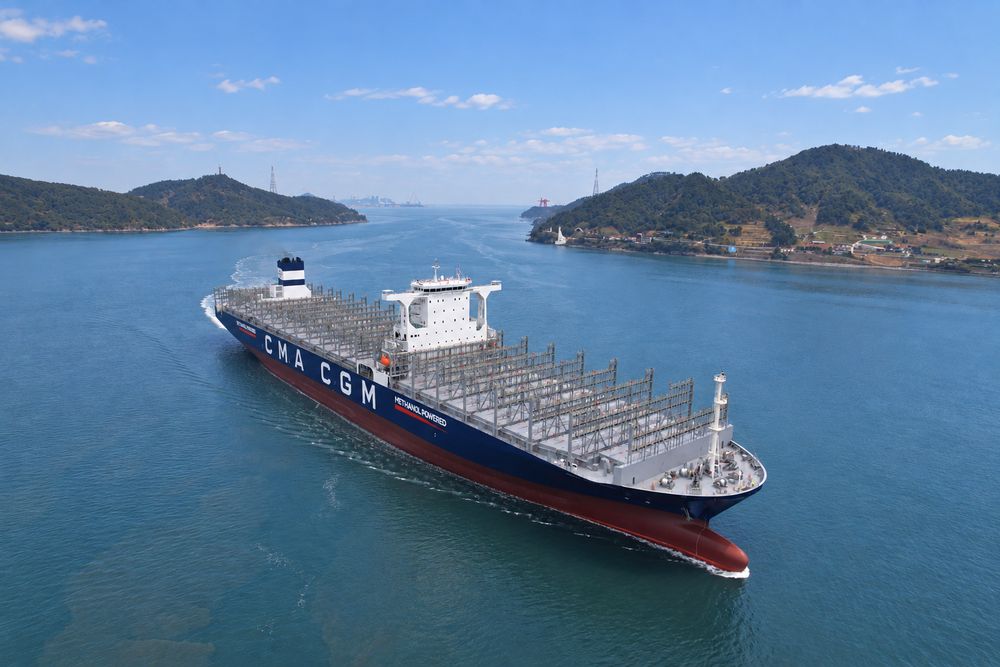
HD Hyundai, the South Korean shipbuilder, announced on 6 October that it has delivered a 13,000 TEU container ship to CMA CGM with cell guides that continue above the deck. Containers stowed in those guides are held by the steel and need no lashing. The yard calls her the world's first lashing-free container ship and says she carries over 10% more cargo weight on deck than a conventional ship of the same type. What that is worth at a port call depends on how much of the deck has guides.
The yard's own announcement says the system is "partially applied". So part of the deck is still secured the conventional way, with twistlocks, rods and turnbuckles fitted by hand from the lashing bridges. A lashing gang still boards.
On a conventional bay, that gang frees the stacks before the crane can lift and secures them again before the ship can sail. In a guided bay the crane starts without waiting for a gang to clear, and the bay is finished when the last box lands. The saving therefore depends on how many bays are guided. HD Hyundai has not said how many bays carry guides. It has published no figure for port time or labour saved.
The guided bays also take something away, because they bring fixed geometry to a deck that used to take almost anything. Where the hatch cover was in the way, the yard fits a "portable bench" between the guides, built to the dimensions of a 40-foot container. A 45-foot box does not fit a 40-foot cell. Whether the deck guides take 20-foot boxes is not stated. Every bench is also a crane lift.
The 10% does not offset that in slots. The figure is a weight, and HD Hyundai has not claimed more slots.
So the planner gets one deck with two sets of rules. The stowage system and the lashing software need the ship modelled with two securing systems, and her Cargo Securing Manual has to describe both.
No rule requires deck guides, so whether this spreads is a commercial decision, and the evidence sits with CMA CGM. The ship is one of a series of 12 built at HD Hyundai Samho. CMA CGM holds the comparison: sisters from the same yard with conventional decks. The thing to watch is whether CMA CGM publishes crane productivity and lashing hours for the guided bays against those sisters.
Primary sources
- officialHD Hyundai Delivers World's First "Lashing-Free" Container Ship HD Hyundai (PR Newswire), 2026-10-06
- CEPA CV - Lashing tool (TT Club Innovation in Safety Award 2025 entry) ICHCA International
- Sub-Committee on Carriage of Cargoes and Containers, 10th session (CCC 10), meeting summary International Maritime Organization, 2024-09-20
- MSC/Circ.608/Rev.1, Interim guidelines for open-top containerships International Maritime Organization (hosted by Deutsche Flagge)
- Mixed stowage Wärtsilä Encyclopedia of Marine and Energy Technology